
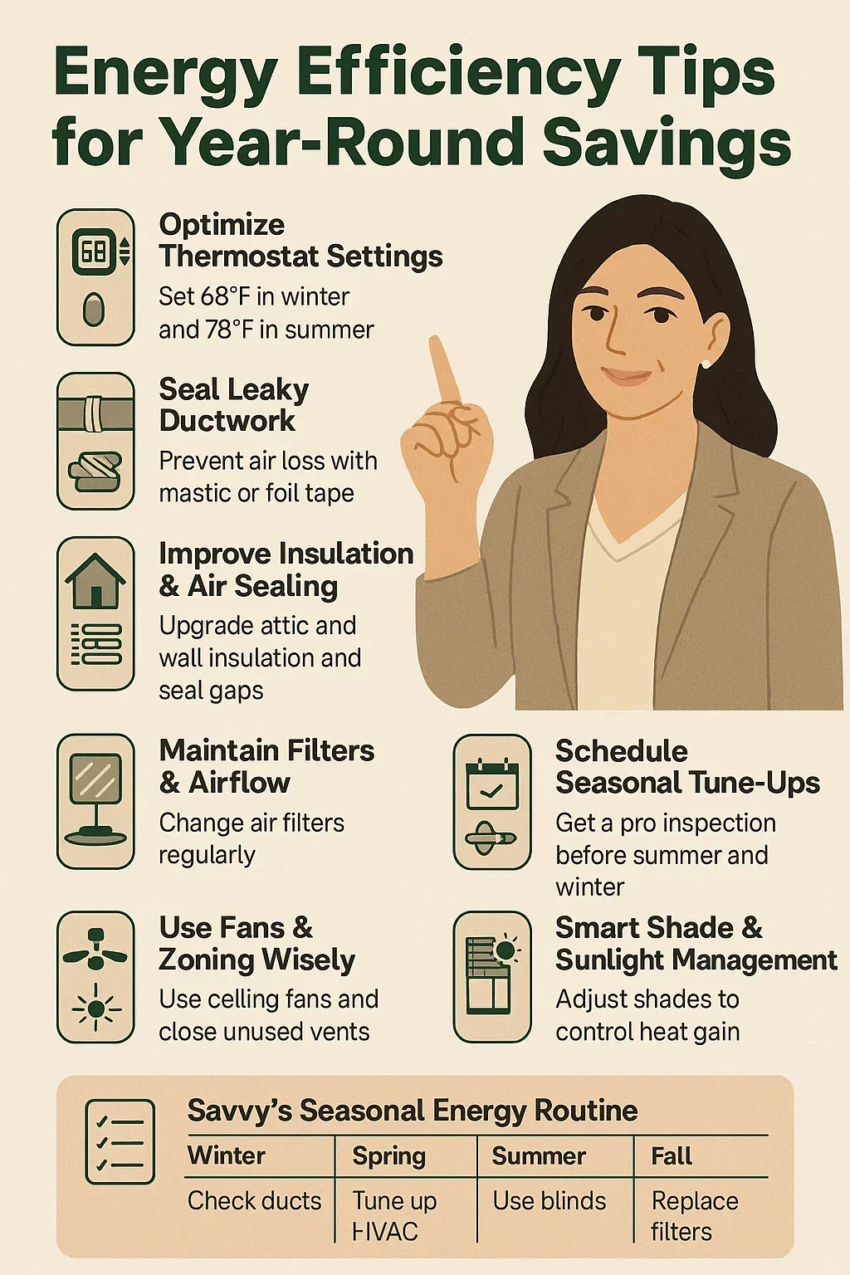
Replacing a heating and cooling system can cost $8,000–$15,000 or more, yet many comfort and efficiency problems originate elsewhere in the home. Before investing in new HVAC equipment, homeowners should address air leaks, insulation gaps, duct issues, and thermostat settings. These targeted fixes often reduce energy bills, improve comfort, and extend system life—without major renovation.
Heating and cooling account for nearly half of the average U.S. home’s energy use, according to the U.S. Energy Information Administration. When energy bills climb or rooms feel uncomfortable, many homeowners assume the HVAC system is failing. In reality, the equipment is often compensating for problems elsewhere—leaky ducts, inadequate insulation, or poor air sealing.
Before committing to a costly replacement, it’s worth asking a more practical question: Is my HVAC system actually the problem—or is my home losing energy?
In many cases, addressing the home’s efficiency first can restore performance, reduce bills, and delay or even eliminate the need for new equipment.
Why HVAC Replacement Isn’t Always the First Step
Modern HVAC systems are engineered to operate efficiently when the home’s building envelope supports them. If air escapes through the attic, ducts leak into crawl spaces, or insulation is insufficient, even a brand-new system will struggle.
The U.S. Department of Energy estimates that air leaks can account for 25–30% of heating and cooling energy consumption in a typical home. That means a significant portion of conditioned air may never reach living spaces.
Replacing the equipment without addressing these issues is comparable to upgrading a car engine while ignoring flat tires.
Before signing a replacement contract, evaluate the following high-impact improvements.
1. Seal Air Leaks Throughout the Home
Air leakage is one of the most common—and fixable—causes of high energy bills.
Warm air escapes during winter, and hot outdoor air enters during summer through:
- Attic penetrations
- Window and door frames
- Baseboards
- Recessed lighting fixtures
- Plumbing and wiring gaps
Air sealing with caulk, foam sealant, and weatherstripping is inexpensive and often DIY-friendly.
A homeowner in Pennsylvania reported uneven temperatures and high winter gas bills. An energy audit revealed significant attic air leakage around recessed lights and the attic hatch. After sealing these gaps and adding weatherstripping, heating costs dropped by approximately 15% the following season.
The ENERGY STAR program confirms that air sealing combined with insulation improvements can reduce total energy bills by up to 20% in many homes.
2. Improve Attic Insulation Before Upgrading Equipment
Many homes built before the 2000s have insulation levels below current recommendations.
The U.S. Department of Energy recommends attic insulation levels between R-38 and R-60 in most U.S. climate zones.
If insulation is thin or uneven, your HVAC system works harder to compensate for heat loss in winter and heat gain in summer.
Before replacing a furnace or air conditioner:
- Measure insulation depth
- Seal air leaks first
- Add blown-in or batt insulation where accessible
Improving attic insulation can significantly reduce heating and cooling loads—sometimes enough to justify a smaller HVAC system when replacement is eventually needed.
3. Inspect and Seal Ductwork
Leaky ducts are a hidden source of inefficiency. The U.S. Department of Energy reports that typical duct systems lose 20–30% of conditioned air through leaks, holes, and poorly connected joints.
This is especially common when ducts run through unconditioned spaces like attics or crawl spaces.
Signs of duct leakage include:
- Rooms that never reach the set temperature
- Excess dust
- Higher-than-average utility bills
- Whistling sounds from vents
Accessible duct runs can be sealed with mastic sealant and insulated to prevent energy loss. In many homes, this upgrade restores comfort without replacing the HVAC unit.
4. Upgrade to a Smart or Programmable Thermostat
Sometimes the issue isn’t the system—it’s how it’s controlled.
According to the U.S. Environmental Protection Agency, homeowners who use properly programmed thermostats can save around 8% annually on heating and cooling costs.
Many older thermostats lack setback features or adaptive learning.
Best practices include:
- Setting heating to 68°F when home in winter
- Lowering temperatures while sleeping
- Raising cooling setpoints during peak summer hours
Smart thermostats can optimize runtime based on occupancy patterns, reducing unnecessary cycling.
5. Address Drafty Windows Before Replacing HVAC
Window replacement is expensive, but full replacement is rarely necessary as a first step.
Instead, consider:
- Replacing worn weatherstripping
- Installing window insulation film during winter
- Using cellular shades or thermal curtains
These measures reduce heat transfer and drafts, improving comfort and lowering system demand.
If rooms near windows feel significantly colder or hotter than the rest of the house, air leakage may be contributing more than HVAC inefficiency.
6. Reduce Water Heating Load
Water heating accounts for roughly 18% of household energy use in the United States, according to the U.S. Energy Information Administration.
Lowering water heating demand can reduce overall utility bills, easing the financial pressure that might otherwise prompt HVAC replacement.
Simple adjustments include:
- Setting water heater temperature to 120°F
- Installing low-flow showerheads
- Insulating hot water pipes
- Fixing leaks promptly
These improvements don’t affect HVAC performance directly but contribute to overall household energy efficiency.
7. Perform a Home Energy Audit
Before replacing major equipment, a diagnostic approach is essential.
Many utilities offer free or subsidized energy audits. These assessments often include:
- Blower door testing
- Infrared thermal imaging
- Duct leakage testing
- Insulation evaluation
An audit can reveal whether your HVAC system is undersized, oversized, or simply compensating for building envelope problems.
In many cases, correcting structural inefficiencies reduces demand enough that the existing system performs adequately.
8. Evaluate System Age and Maintenance History
Of course, not all HVAC systems should be preserved indefinitely.
Consider replacement if:
- The system is 15–20 years old
- Repair costs exceed 50% of replacement cost
- Refrigerant is obsolete (such as R-22 systems)
- Frequent breakdowns occur
However, if the system is under 12 years old and structurally sound, envelope improvements may provide better financial returns than immediate replacement.
Routine maintenance—including filter replacement, coil cleaning, and refrigerant checks—can also restore efficiency.
Frequently Asked Questions
1. How do I know if my HVAC system really needs replacing?
Frequent repairs, rising energy bills despite maintenance, and age over 15–20 years are common indicators.
2. Can insulation improvements lower energy bills more than a new system?
In under-insulated homes, yes. Insulation often delivers greater immediate savings.
3. Is duct sealing worth it?
Yes. Duct leaks can waste up to 30% of conditioned air.
4. How much can air sealing save?
Air sealing combined with insulation can reduce energy bills by up to 20%.
5. Should I replace windows before HVAC?
Usually not. Air sealing and insulation offer better cost-effectiveness.
6. Do smart thermostats really reduce costs?
Yes, when properly programmed and used consistently.
7. What’s the average HVAC replacement cost?
Costs commonly range between $8,000 and $15,000 depending on system type and region.
8. How long should a furnace or AC last?
Most systems last 15–20 years with proper maintenance.
9. What is the fastest DIY fix?
Weatherstripping and sealing attic penetrations are among the quickest improvements.
The Smarter Investment Decision
Replacing an HVAC system may eventually be necessary, but in many homes, energy waste originates elsewhere. Addressing air leakage, insulation gaps, duct inefficiencies, and thermostat programming often delivers measurable savings while improving comfort.
The most cost-effective path is rarely immediate replacement. Instead, focus on reducing demand first. When the home itself performs efficiently, HVAC equipment operates more effectively—and lasts longer.
What to Evaluate Before Signing an HVAC Contract
- Check for attic and door air leaks
- Measure insulation levels
- Inspect ductwork for leaks
- Upgrade thermostat controls
- Review system maintenance history
- Compare repair costs vs. replacement
- Request a home energy audit