

Summary:
Hustle culture promises success through relentless work, but its hidden costs include burnout, anxiety, strained relationships, and long-term health damage. Fueled by social media narratives and productivity obsession, this mindset often sacrifices well-being for validation. Backed by research from organizations like the World Health Organization and Gallup, this article exposes the real price of nonstop grinding—and how to reclaim balance without sacrificing ambition.
What Is Hustle Culture—And Why Is It So Popular in America?
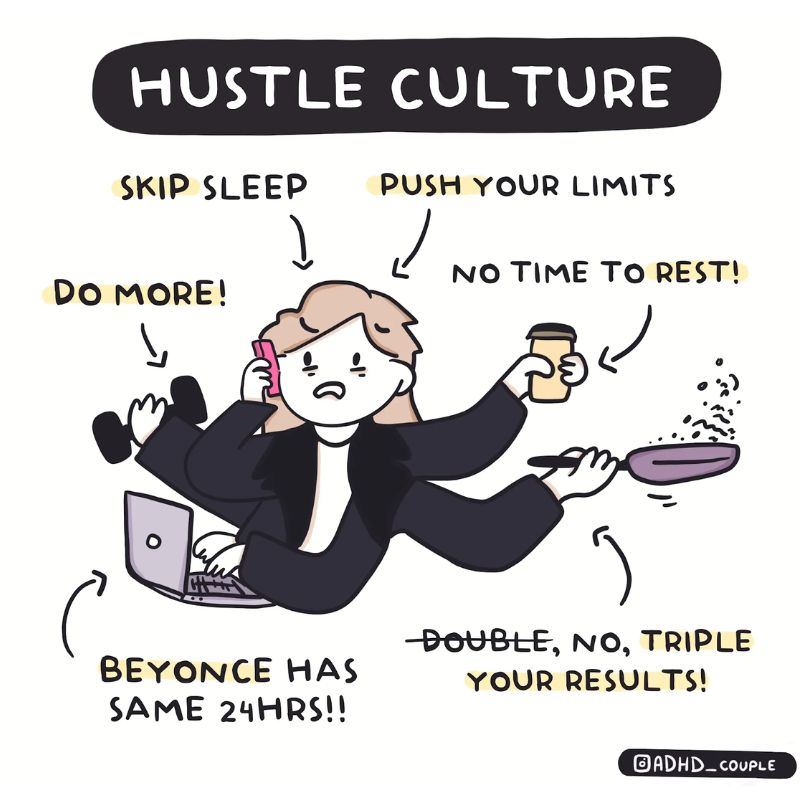
Hustle culture refers to a belief system that equates constant work, productivity, and ambition with personal value and moral virtue. It promotes the idea that downtime equals laziness and that success requires relentless effort.
In the United States, this mindset is deeply rooted in the “American Dream” ethos—where hard work is synonymous with upward mobility. Social media has amplified it. Platforms reward visible busyness: 5 a.m. routines, side hustles, 80-hour weeks, and aesthetic desk setups.
But the psychology behind it is more complex. Hustle culture thrives because it offers:
- A clear identity (“I’m driven”)
- Social validation (“You’re inspiring!”)
- A sense of control in uncertain times
- The illusion that burnout is temporary, but success is permanent
The problem? The body and brain don’t operate on motivational slogans.
Is Hustle Culture Actually Harmful?
Yes—and research confirms it.
In 2021, the World Health Organization and the International Labour Organization reported that working 55 hours or more per week is associated with a significantly higher risk of stroke and heart disease. Meanwhile, workplace analytics from Gallup consistently show that burned-out employees are far less productive and far more likely to quit.
The harm isn’t abstract. It’s measurable. But the most dangerous effects are often invisible at first.
The 7 Hidden Costs of Hustle Culture
1. Chronic Stress That Feels “Normal”
When Emily, a 32-year-old marketing manager in Chicago, started waking up with chest tightness and racing thoughts, she assumed it was just “part of the grind.” She had internalized the belief that anxiety meant she was pushing hard enough.
Chronic stress becomes normalized in hustle culture. You tell yourself:
- “I’ll rest after this launch.”
- “Once I hit this milestone, it’ll calm down.”
- “Everyone in my field works like this.”
But your nervous system doesn’t distinguish between ambition and threat. Elevated cortisol over time contributes to:
- Insomnia
- Digestive problems
- Hormonal imbalance
- Increased cardiovascular risk
The cost isn’t just discomfort—it’s biological.

2. Identity Becomes Tied to Productivity
One of the most dangerous shifts in hustle culture is subtle: you stop asking “Who am I?” and start asking “What did I accomplish today?”
Consider Jason, a startup founder who sold his company at 35. Instead of relief, he felt empty. Without the grind, he didn’t know who he was. His self-worth had been fused to constant motion.
This identity collapse is common among:
- Entrepreneurs post-exit
- Corporate climbers after layoffs
- High achievers during career transitions
When your value equals output, rest feels threatening.
3. Relationships Become Transactional
Hustle culture reframes time as currency. Every moment must “produce” something. That perspective subtly reshapes relationships.
You might:
- Schedule date nights like business meetings
- View networking as more important than genuine connection
- Feel impatient during slow, unstructured family time
Over time, loved ones feel deprioritized—even if unintentionally. Divorce attorneys frequently cite overwork as a contributing factor in marital breakdowns. And children of chronically overworked parents often describe emotional distance more than material absence.
The hidden cost? You win professionally but lose relationally.
4. Sleep Deprivation Is Glorified
“Sleep is for the weak” is a phrase that should have died years ago.
Sleep deprivation impairs:
- Decision-making
- Emotional regulation
- Creativity
- Immune function
Yet hustle culture frames 4-hour nights as heroic. Ironically, research from performance science consistently shows that adequate sleep improves productivity more than working longer hours. Elite athletes prioritize recovery. Yet knowledge workers often ignore it. Burnout doesn’t begin with collapse—it begins with consistent sleep sacrifice.
5. The Illusion of Financial Security
Many people justify overworking with one phrase: “I’m building freedom.” But here’s the paradox: the more money you make under hustle culture, the more your lifestyle expands to match it. Bigger house. More subscriptions. Higher expectations. Soon, your financial freedom depends on maintaining your burnout pace.
Instead of buying time, hustle often buys obligation.
6. Creativity Declines Over Time
Hustle culture prioritizes output over reflection. But innovation requires white space. When your calendar has no margin:
- Strategic thinking shrinks
- Problem-solving becomes reactive
- Big ideas get replaced by quick execution
Some of the most successful CEOs schedule deliberate “thinking time.” Yet most professionals feel guilty for unscheduled hours. Constant motion suppresses deep creativity.
7. Burnout Isn’t Just Exhaustion—It’s Emotional Numbness
Burnout isn’t just being tired. It’s cynicism. It’s detachment. It’s loss of meaning. According to workplace psychology research, burnout includes:
- Emotional exhaustion
- Depersonalization
- Reduced sense of accomplishment
People often describe it as “feeling nothing.” That’s the hidden cost no one warns you about—the slow fading of enthusiasm that once fueled the hustle in the first place.
Why Do So Many High Achievers Fall Into Hustle Culture?
This question is trending across search platforms because people are starting to notice the pattern.
Common drivers include:
- Fear of falling behind in competitive industries
- Social comparison fueled by curated online success
- Student loan pressure and rising living costs
- Cultural conditioning equating rest with laziness
- Early praise for achievement rather than character
For many Americans, hustle isn’t ego-driven—it’s survival-driven. That’s what makes it so hard to challenge.
Is Hustle Culture the Same as Ambition?
No—and this distinction is critical.
Ambition is goal-oriented. Hustle culture is identity-oriented. Ambition says, “I want to achieve something meaningful.” Hustle culture says, “I must constantly prove I am valuable.”
Healthy ambition allows rest. Hustle culture punishes it.
Real-Life Signs You’re Paying the Hidden Cost
Ask yourself:
- Do you feel anxious when you’re not working?
- Has your sleep quality declined in the past year?
- Do loved ones say you’re distracted?
- Does downtime trigger guilt?
- Do you struggle to enjoy achievements before chasing the next goal?
If you answered yes to several, the cost may already be accumulating.
How to Break Free Without Killing Your Career
The solution isn’t quitting your job and moving off-grid. It’s recalibrating your relationship with work. Here’s how high performers are redefining success:
1. Redefine Productivity
Measure output in outcomes, not hours logged.
2. Schedule Recovery Like Strategy
Block rest time as non-negotiable.
3. Set Upper Limits
Decide in advance how many hours per week is your maximum.
4. Separate Identity From Occupation
Cultivate hobbies, community, and interests outside work.
5. Audit Your Financial Lifestyle
Ensure your expenses don’t require chronic overwork.
6. Normalize Boundaries
High-level professionals increasingly communicate clear availability windows—and performance doesn’t suffer.
10 Trending FAQs About Hustle Culture
1. Is hustle culture toxic?
It can be when it promotes chronic overwork, identity fusion with productivity, and neglect of health and relationships.
2. What are the psychological effects of hustle culture?
Increased anxiety, burnout, emotional detachment, and reduced self-worth tied to performance.
3. Why is hustle culture so common in the U.S.?
Cultural emphasis on the American Dream, social mobility narratives, and social media amplification.
4. Can you be successful without hustling nonstop?
Yes. Sustainable performance models consistently outperform burnout cycles long term.
5. What’s the difference between hard work and hustle culture?
Hard work has boundaries. Hustle culture erases them.
6. Does hustle culture cause burnout?
It significantly increases burnout risk, especially when recovery is ignored.
7. How do I know if I’m burned out or just tired?
Burnout includes cynicism, detachment, and loss of motivation—not just fatigue.
8. How many hours is too many?
Research indicates consistent work beyond 55 hours weekly increases health risks.
9. Why do entrepreneurs glorify hustle?
Startup culture often romanticizes sacrifice, especially in early growth stages.
10. How can I recover from hustle culture burnout?
Prioritize sleep, therapy or coaching, boundary setting, workload reduction, and gradual nervous system recovery.
The Future of Work: Is Hustle Culture Dying?
There are signs of a shift. Movements emphasizing:
- Work-life integration
- Mental health transparency
- Flexible schedules
- Results-only work environments
are gaining traction. Post-pandemic, many Americans are questioning whether nonstop grinding truly delivers fulfillment. High performance is evolving from “maximum effort” to “optimized sustainability.”
The Real Redefinition of Success
Success isn’t just accumulation. It’s sustainability. Imagine two professionals:
- One burns bright for 10 years and collapses.
- The other operates at 80% intensity for 40 years.
Which one wins? The hidden cost of hustle culture is time—not clock time—but life quality time. And no promotion refunds that.
Final Takeaways
- Hustle culture equates productivity with worth.
- Chronic overwork increases serious health risks.
- Burnout affects identity, relationships, and creativity.
- Sustainable ambition outperforms relentless grinding.
- Redefining success protects both achievement and well-being.
You don’t have to choose between success and sanity. But you do have to choose sustainability over spectacle.