
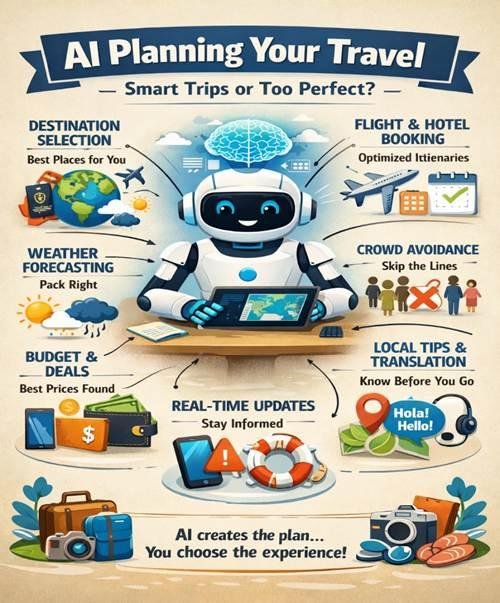
AI has quietly become the most powerful travel planning assistant Americans have ever had. From predicting flight prices to building hyper-personalized itineraries in seconds, artificial intelligence is replacing hours of research with smarter, faster, and cheaper decisions. This guide explains how AI is transforming travel planning, why Americans trust it, and how to use it to plan better vacations—without losing the human touch.
Why Are Americans Turning to AI for Travel Planning?
Search trends show a sharp rise in queries like “AI travel planner,” “best AI for trip planning,” and “can AI plan my vacation.” The reason is simple: traditional travel planning is broken.
Americans are overwhelmed by options. Hundreds of tabs, conflicting reviews, surge pricing, and endless comparison fatigue have turned what should be an exciting process into a stressful one. AI steps in as a filter, optimizer, and decision-maker—not by replacing choice, but by simplifying it.
A San Diego-based working mom described her experience this way: “I used to spend three nights planning trips. Now I spend 15 minutes—and I get better results.”
What Does AI Actually Do in Travel Planning?
AI doesn’t “guess.” It analyzes massive datasets—prices, reviews, traveler behavior, seasonality, and personal preferences—then delivers recommendations tailored to you.
Modern AI travel tools can:
- Predict flight price changes
- Build full itineraries from a few prompts
- Recommend hotels based on travel style, not ads
- Adjust plans in real time when delays happen
Major platforms powered by companies like Google, Expedia, and Booking.com now integrate AI deeply into their planning tools.
How AI Is Replacing the Old Way of Planning Trips
Then: Manual, Fragmented, Time-Consuming
Travelers jumped between blogs, forums, spreadsheets, and booking sites. Decisions were influenced by SEO, ads, and outdated advice.
Now: Centralized, Personalized, Fast
AI pulls from thousands of sources instantly and ranks options based on relevance—not popularity alone.
A Chicago consultant recently asked an AI planner to “build a 5-day foodie trip to Lisbon under $2,000.” Within seconds, she had flights, neighborhoods, restaurant recommendations, and a daily plan—something that once took hours.
Is AI Really Making Vacations Smarter?
Yes—and in three critical ways.
1. Smarter Spending Decisions
AI predicts when to book flights and hotels by analyzing historical pricing patterns. Instead of “book now or wait?” anxiety, travelers get confidence.
2. Smarter Time Use
AI groups attractions geographically, optimizes routes, and avoids overpacking days. This reduces burnout and increases enjoyment.
3. Smarter Experiences
Instead of generic “Top 10” lists, AI recommends experiences aligned with personal interests—whether that’s quiet cafés, kid-friendly museums, or hidden hiking trails.
Real-Life Examples of AI in Action
- A Dallas couple saved $420 by following an AI-generated alert to book flights two weeks earlier than planned.
- A solo traveler used AI to redesign her Rome itinerary after a train strike—within minutes.
- A retired veteran used AI to plan a slow-paced national park road trip that accommodated mobility needs.
These aren’t edge cases. They’re becoming normal.
What Types of AI Travel Tools Are Americans Using Most?
AI travel tools fall into several categories, often working together.
Most-used AI travel applications include:
- AI itinerary builders
- Flight price prediction engines
- Hotel recommendation algorithms
- Chat-based travel assistants
- AI-powered review summarizers
Some travelers use one tool. Power users combine several.
Does AI Remove the Joy of Discovery?
This is a common concern—and a fair one.
But most travelers report the opposite. By removing logistical stress, AI frees mental space for curiosity.
AI doesn’t tell you what to feel. It helps you get to the moment where feeling happens.
A travel writer from Brooklyn said it best: “AI handled the boring parts. I handled the wonder.”
How Accurate Is AI for Travel Planning?
Accuracy depends on input quality. The clearer your preferences, the better the output.
AI excels at:
- Pattern recognition
- Price forecasting
- Large-scale comparison
It’s weaker at:
- Emotional nuance
- Last-mile local quirks
That’s why the smartest travelers treat AI as a co-pilot, not an autopilot.
Can AI Really Save Money on Travel?
In many cases, yes.
AI saves money by:
- Avoiding peak pricing windows
- Recommending alternative airports or dates
- Highlighting high-value neighborhoods
- Preventing overbooking and redundant transport
According to multiple industry analyses cited by travel platforms, travelers using AI-assisted tools report 10–30% average savings on total trip costs.
Is AI Travel Planning Safe and Trustworthy?
Trust is critical—and improving fast.
Reputable AI travel tools:
- Pull from verified data sources
- Clearly label sponsored results
- Allow manual overrides
- Learn from user feedback
Privacy-conscious travelers can opt out of data retention and still benefit from planning assistance.
Who Benefits Most From AI Travel Planning?
AI helps almost everyone—but certain groups benefit disproportionately.
High-impact user groups:
- Busy professionals
- Families with complex logistics
- Budget-conscious travelers
- Neurodivergent travelers who prefer structure
- First-time international travelers
For these groups, AI isn’t a luxury—it’s a relief.
What AI Still Can’t Replace (Yet)
AI can’t replace:
- Human intuition
- Local storytelling
- Emotional resonance of spontaneous discovery
And that’s a good thing.
The future of travel isn’t AI instead of humans—it’s AI supporting better human experiences.
Trending FAQs Americans Are Asking About AI Travel
1. What is the best AI travel planner right now?
It depends on whether you prioritize price, itinerary depth, or flexibility.
2. Is AI travel planning free?
Many tools offer free versions with premium upgrades.
3. Can AI plan international trips?
Yes—often more effectively than domestic ones.
4. Does AI replace travel agents?
For simple trips, yes. For luxury or complex travel, they complement each other.
5. How accurate are AI flight predictions?
Highly accurate for trends, not guarantees.
6. Can AI plan family vacations?
Yes—especially helpful for balancing interests and pacing.
7. Is AI good for last-minute travel?
Very. It excels at rapid optimization.
8. Will AI recommend tourist traps?
Less likely—it prioritizes relevance over popularity.
9. Is AI travel planning safe with personal data?
Reputable platforms follow strict data policies.
10. Will AI completely automate travel planning?
Unlikely. Human input remains essential.
How to Use AI for Smarter Travel (Practical Takeaways)
- Be specific with preferences
- Use AI early, then refine
- Combine AI insight with human judgment
- Always sanity-check recommendations
AI rewards clarity.
Why AI Is the Future of Travel Planning—Not a Fad
AI adoption in travel isn’t slowing—it’s accelerating. As models improve and personalization deepens, planning will feel less like work and more like storytelling.
Travelers who adopt AI early gain:
- Better value
- Less stress
- More meaningful trips
The spotlight has shifted—and AI earned it.