
Quick Summary
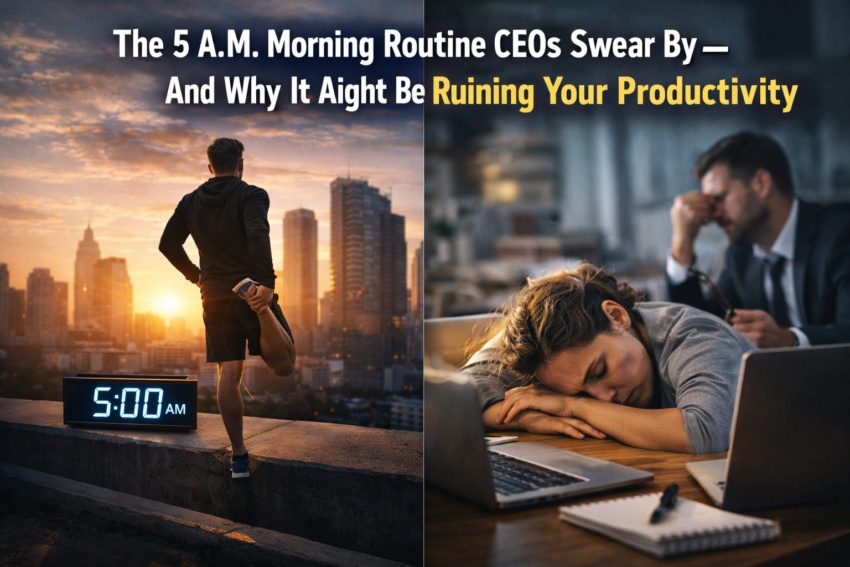
The 5 a.m. morning routine has become a modern symbol of discipline, ambition, and high performance. Many CEOs and entrepreneurs praise early rising as their secret weapon. But research in sleep science and productivity reveals a deeper truth: waking at 5 a.m. can either sharpen your edge—or quietly erode your focus, mood, and long-term output. The difference lies in sleep quality, chronotype alignment, and sustainable habit design.
Why the 5 A.M. Routine Became a Status Symbol
Over the past decade, waking at 5 a.m. has shifted from a personal preference to a public badge of honor. Business leaders frequently cite early rising as a cornerstone of their success. Leaders like Tim Cook, Howard Schultz, and Indra Nooyi have openly discussed starting their days before sunrise.
Self-development culture amplified the idea further through The 5 AM Club by Robin Sharma, which popularized the concept of structured early mornings as a gateway to elite performance.
The appeal is understandable. Early mornings offer:
- Silence before emails flood in
- Zero interruptions from meetings
- Time for strategic thinking
- A psychological sense of control
For executives managing large teams and complex decisions, uninterrupted time is rare. A 5 a.m. start creates space for proactive work instead of reactive work.
But here’s the critical nuance: many high-performing CEOs also go to bed early. That part rarely trends on social media.
What Does Science Actually Say About Waking Up at 5 A.M.?
One of the most searched questions in the U.S. is:
“Is waking up at 5 a.m. healthy?”
The answer depends entirely on sleep duration and biological rhythm.
The CDC recommends 7–9 hours of sleep per night for adults. Chronic sleep restriction is linked to:
- Impaired decision-making
- Reduced memory consolidation
- Lower emotional regulation
- Increased risk of cardiovascular disease
Research published in Nature Communications shows that even moderate sleep restriction significantly reduces cognitive flexibility—the very trait required for innovation and leadership.
In practical terms:
- Waking at 5 a.m. after 8 hours of sleep → likely beneficial.
- Waking at 5 a.m. after 5–6 hours → cognitive decline over time.
Sleep deprivation doesn’t feel dramatic. It accumulates subtly, often masked by caffeine and adrenaline.
The Real Reason CEOs Wake Up Early
It’s not about the clock.
It’s about control.
Executives operate in high-interruption environments. Early mornings allow:
- Deep work without Slack notifications
- Exercise before long workdays
- Intentional planning instead of reactive responding
A tech founder in Austin implemented a 5–7 a.m. deep work block and reported fewer strategic mistakes and more confident decisions. However, she maintained a strict 9:30 p.m. bedtime.
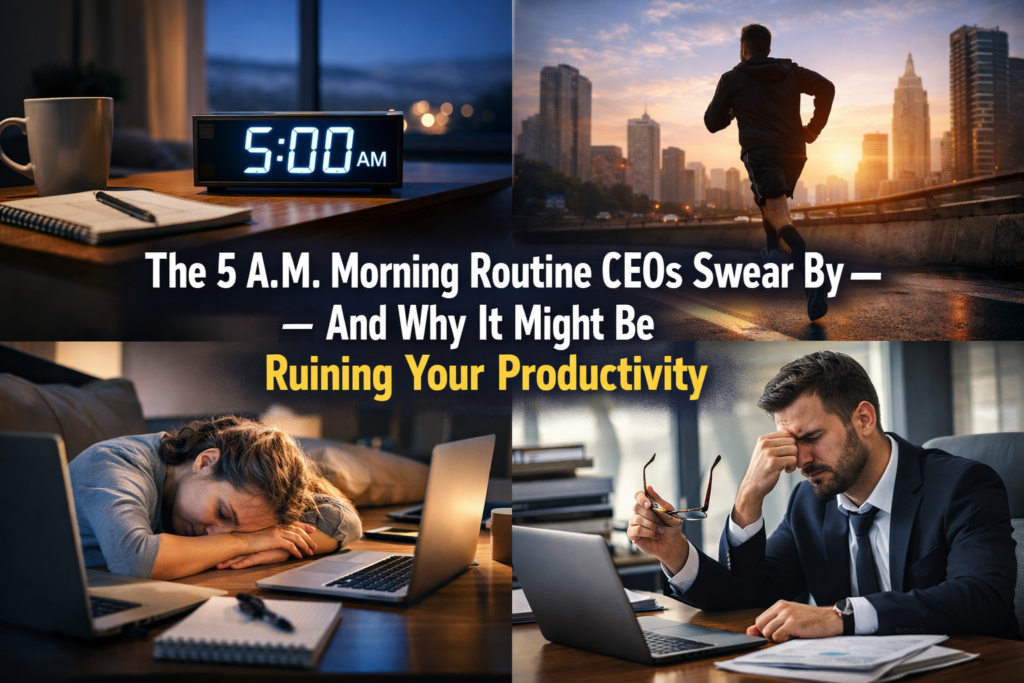
Contrast that with Mark, a Chicago marketing director who adopted a 5 a.m. routine inspired by productivity influencers. He kept his midnight bedtime. Within weeks, he noticed:
- Afternoon brain fog
- Increased irritability
- Lower creative output
- Heavy caffeine dependence
When he shifted to a 6:30 a.m. wake-up with 8 hours of sleep, his productivity improved significantly.
The difference wasn’t discipline.
It was recovery.
Are Early Risers More Successful?
Studies suggest that morning-oriented individuals often report higher life satisfaction. But correlation does not equal causation.
Success is driven more by:
- Consistency
- Energy management
- Focused execution
- Emotional stability
Some top-performing professionals peak in the evening. Writers, engineers, designers, and creatives often report optimal cognitive output later in the day.
Your biological chronotype matters.
Forcing a night owl into a 5 a.m. schedule can reduce performance rather than improve it.
What Happens to Your Brain When You Cut Sleep Short?
Sleep cycles last roughly 90 minutes. If you wake during deep sleep, you experience sleep inertia—a groggy state that can impair performance for up to an hour.
Chronic early rising without adequate sleep can lead to:
- Slower reaction times
- Poor risk assessment
- Increased emotional reactivity
- Reduced working memory
In leadership roles, those deficits translate into real business consequences.
Ironically, many executives who wake at 5 a.m. protect their sleep fiercely. They optimize their environment, limit late-night screen exposure, and treat bedtime as non-negotiable.
The Psychological Benefits of an Early Morning Routine
When aligned with adequate sleep, early rising can provide:
- Calm before chaos
- Structured self-reflection
- Habit consistency
- Reduced morning stress
- Higher perceived control
A New York startup founder describes her 5 a.m. hour as “mental clarity training.” She journals, stretches lightly, and identifies her top three priorities for the day.
Her rule: If she gets less than 7.5 hours of sleep, she skips the early wake-up.
Flexibility prevents burnout.
The Hidden Productivity Trap: Hustle Culture
Social media glamorizes extreme discipline. Photos of 5:03 a.m. gym check-ins generate admiration.
But productivity isn’t performance theater.
When early rising is driven by comparison rather than alignment, it often results in:
- Sleep debt accumulation
- Hormonal stress increases
- Afternoon crashes
- Reduced long-term output
The real productivity metric isn’t wake-up time.
It’s sustainable energy.
How to Know If the 5 A.M. Routine Is Right for You
Ask yourself:
- Do I naturally wake early without an alarm?
- Can I consistently sleep before 10 p.m.?
- Is my cognitive peak in the morning?
- Do I feel energized or depleted by early starts?
- Am I waking early out of purpose or pressure?
If your answers lean toward natural alignment, the 5 a.m. routine may enhance performance.
If not, forcing it may undermine your productivity.
A Smarter Alternative: Build an Energy-First Morning Routine
Instead of copying CEOs, design a routine based on biology and lifestyle.
Core elements of high-performance mornings:
- 7–9 hours of sleep
- Morning sunlight exposure
- 10–20 minutes of movement
- Clear daily priorities (top 3 tasks)
- Limited phone usage in the first 30 minutes
Notice that none of these require 5 a.m.
A Los Angeles corporate attorney moved from a 5 a.m. wake-up to 6:45 a.m., added morning sunlight and short mobility work, and reported improved focus and higher billable efficiency.
Energy beats ego every time.
10 Frequently Asked Questions (SEO-Optimized)
1. Is waking up at 5 a.m. good for productivity?
It can improve productivity if paired with sufficient sleep and structured focus time. Without adequate rest, it decreases cognitive performance.
2. How many hours of sleep do I need if I wake up at 5 a.m.?
Most adults need 7–9 hours. That means sleeping between 8:00–10:00 p.m.
3. Why do so many CEOs wake up early?
Early mornings provide uninterrupted strategic thinking time before workday demands begin.
4. Can waking up at 5 a.m. improve mental health?
It may reduce stress if it creates structure. It worsens mood if it causes sleep deprivation.
5. What are the disadvantages of waking up too early?
Fatigue, reduced focus, emotional instability, increased caffeine reliance, and long-term burnout.
6. Is the 5 a.m. club scientifically proven?
There is no universal evidence that 5 a.m. specifically increases success. Sleep quality matters more than wake-up time.
7. How long does it take to adjust to a 5 a.m. schedule?
Typically 2–3 weeks of gradual bedtime adjustments.
8. Are night owls less productive?
No. Productivity depends on alignment with natural circadian rhythms.
9. Should I exercise at 5 a.m.?
If fully rested and energized, yes. If sleep-deprived, prioritize rest.
10. What’s better: waking up at 5 a.m. or staying up late?
Whichever allows you consistent 7–9 hours of sleep and matches your peak cognitive window.
Final Verdict: Productivity Is About Energy, Not Time
The 5 a.m. routine is not a magic formula. It’s a tool. For some, it creates clarity and momentum. For others, it erodes focus and well-being.
The most successful professionals prioritize:
- Sleep quality
- Strategic focus
- Sustainable routines
- Energy management
Waking up at 5 a.m. doesn’t guarantee success.